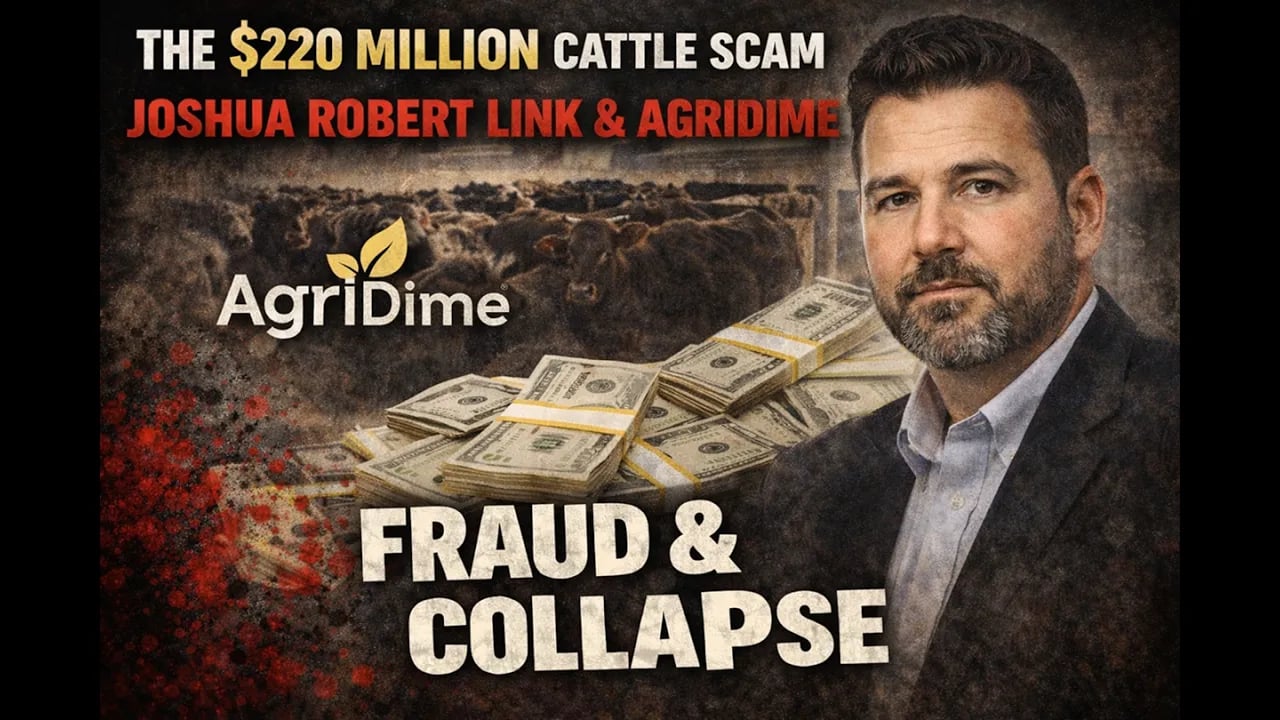
The $220 Million Cattle Investment Scam That Shook Investors
A $220M cattle investment scheme collapsed after federal investigations revealed missing livestock and alleged fraud. Learn the key lessons real estate investors must know.
There is something about tangible investments that feels safe.
Land. Property. Livestock. Physical assets create a sense of security because you can visualize them. You can point to them. They feel real.
That sense of security is exactly what helped a Texas company attract more than $220 million from over 2,200 investors across the United States. What started as a seemingly straightforward cattle investment opportunity eventually became the center of a federal investigation, criminal indictments, and an ongoing manhunt.
For investors in real estate and other asset-backed opportunities, the story carries critical lessons.
Watch the Full Video
The Investment Pitch That Attracted Thousands
A Fort Worth, Texas company called Agridime LLC offered investors a simple proposition.
Instead of buying land or managing cattle directly, investors could purchase cattle contracts. The company claimed it would handle the livestock management, care, and sale.
The promise was straightforward:
-
Investors contribute capital
-
The company purchases and manages cattle
-
Profits are generated when the livestock are sold
-
Investors receive strong returns
There was no need for farmland, ranching knowledge, or experience in the commodities market. Investors could simply participate in the booming beef industry.
The returns were attractive. In some cases, investors were promised double-digit returns. High enough to generate excitement but tied to a familiar asset that made the opportunity feel grounded.
It was not cryptocurrency.
It was not a speculative tech startup.
It was cattle.
That framing made the opportunity feel stable and understandable to many investors.
When Federal Investigators Started Asking Questions
Over time, regulators began taking a closer look at the company’s operations.
Both the Securities and Exchange Commission (SEC) and the Commodity Futures Trading Commission (CFTC) launched investigations. Civil actions followed, and authorities froze company assets while they reviewed the underlying business model.
According to federal allegations, the number of cattle owned by the company did not match the volume of contracts sold to investors.
Prosecutors claim:
-
The livestock inventory was insufficient to back the contracts issued
-
Funds from newer investors were used to pay earlier investors
-
Certain financial movements were not disclosed to investors
These accusations mirror the structure commonly seen in Ponzi-style investment schemes.
When an investment structure depends heavily on new incoming money, it becomes vulnerable the moment investor inflows slow down.
That is when many financial schemes begin to collapse.
Criminal Charges and a Fugitive
The investigation eventually escalated beyond civil enforcement.
A federal grand jury indicted five individuals connected to the company on charges including:
-
Wire fraud
-
Conspiracy
-
Money laundering
If proven in court, these charges carry the potential for significant prison sentences.
Four defendants appeared to face the charges.
One did not.
Joshua Link, one of the indicted individuals, failed to appear and is now considered a fugitive by federal authorities. The FBI has requested information about his whereabouts.
When someone disappears during a financial investigation, the narrative changes dramatically. What begins as a regulatory case suddenly becomes a criminal pursuit.
Financial crimes typically unfold quietly in court filings and spreadsheets. A missing defendant introduces an entirely different layer of urgency.
Why This Case Matters to Real Estate Investors
At first glance, cattle investing and real estate might seem unrelated.
But the psychology behind the investment pitch is nearly identical.
Many real estate opportunities are marketed around the same idea. The asset is tangible. It exists physically. You can see the property, visit the land, or walk through the building.
That tangibility lowers skepticism.
Investors often assume the numbers must be legitimate simply because the asset is real.
But physical assets do not guarantee financial transparency.
A contract tied to land, buildings, or livestock can still be structured in a way that fails.
Six Lessons Every Investor Should Remember
1. Tangible Does Not Mean Transparent
A real asset does not automatically mean the financial structure behind it is sound.
Fraud often occurs in the deal structure, financial reporting, or investor agreements. Not in the existence of the asset itself.
2. High Returns Require Higher Scrutiny
Whenever returns approach 15% to 30% annually, investors should increase their level of due diligence.
Higher returns should always come with deeper verification and documentation.
3. Verify Inventory and Assets Independently
In the Agridime case, federal authorities allege that the company did not have enough cattle to support its contracts.
In real estate, this translates to verifying:
-
Property ownership
-
Unit counts
-
Occupancy rates
-
Rent rolls
-
Liens and debt obligations
Never rely solely on internal reports from the operator.
4. Follow the Cash Flow
Fraud thrives on compelling stories.
Legitimate investments survive on verifiable financial data.
If new investor money is required to pay earlier investors, the structure may be unstable.
5. Reputation Can Collapse Overnight
Companies can appear legitimate for years.
They may have offices, marketing materials, contracts, and a professional brand.
But a single indictment can change everything instantly.
Reputation is fragile in the investment world.
6. When Leadership Disappears, Pay Attention
Executives who believe they can defend themselves typically appear in court.
When leadership vanishes during an investigation, it often signals deeper problems within the organization.
What Happens Next
The case against the remaining defendants will continue in federal court.
Meanwhile, more than 2,200 investors are still waiting to learn how much of their money may ultimately be recovered.
Unfortunately, in many fraud cases, losses are rarely fully repaid. Even when convictions occur, recovering the original capital can be extremely difficult.
Until the missing defendant is located, the story remains unfinished.
But the lesson is already clear.
An investment can be tied to something real and still collapse if the underlying financial structure is flawed.
Frequently Asked Questions
What was the Agridime cattle investment scheme?
Agridime allegedly sold cattle investment contracts to thousands of investors, promising returns when livestock were sold. Federal investigators claim the company did not own enough cattle to support the contracts issued.
How much money was involved?
More than $220 million was reportedly invested by over 2,200 investors across the United States.
What charges are the defendants facing?
Federal prosecutors filed charges including wire fraud, conspiracy, and money laundering.
Why is one suspect considered a fugitive?
Joshua Link, one of the indicted individuals, did not appear to face charges and is currently being sought by federal authorities.
What can real estate investors learn from this case?
The key takeaway is that tangible assets do not guarantee transparency. Investors should always verify financial structures, documentation, and cash flow independently.
Final Thoughts for Real Estate Investors
Asset-backed investments can be powerful wealth-building tools when structured properly. Real estate remains one of the most reliable paths to long-term financial growth.
But every opportunity requires careful due diligence.
Whether the investment involves land, rental properties, development projects, or alternative assets, the same rule applies.
Trust the asset.
Verify the structure.
And always follow the numbers.