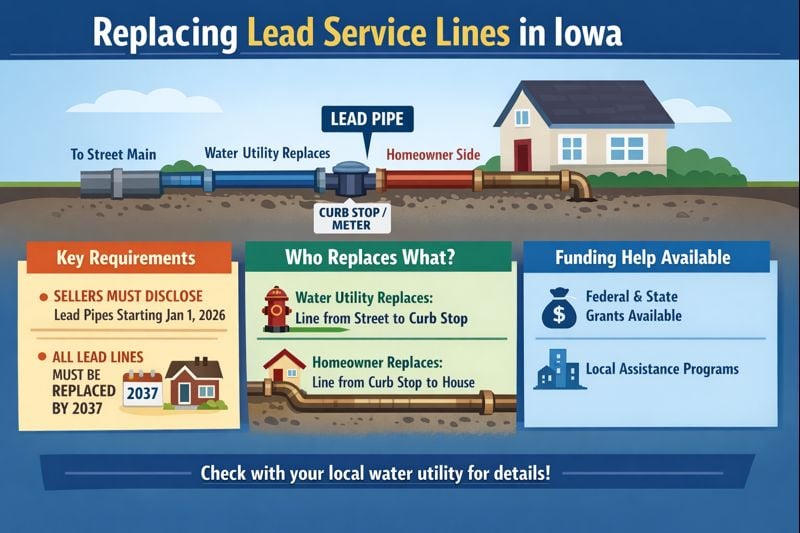
Iowa is adding a new disclosure item in 2026
Beginning January 1, 2026, Iowa real estate sellers will be required to disclose whether a property has a lead service line, when that information is known. This update increases transparency for buyers and aligns with broader national efforts to remove lead from drinking water infrastructure.
What is a lead service line?
A service line is the pipe that connects a home to the public water main. In older neighborhoods, especially homes built before the mid twentieth century, this service line may be made of lead, or contain lead components. A lead service line can raise health concerns and also become a planning issue for future replacement.
Does this new Iowa disclosure law force replacement at the time of sale?
No. The disclosure requirement is not the same as a replacement requirement. The Iowa change focuses on disclosure in the real estate transaction, meaning sellers must share what they know so buyers can make informed decisions.
Where else do sellers have to disclose this?
Iowa is not alone. A few other states already require sellers to disclose lead plumbing or service lines as part of property condition statements when they are known. These include Connecticut, Delaware, New York, and Virginia. Rhode Island has also implemented lead service line disclosure requirements to buyers and tenants. In many other states, lead is covered as part of general material fact disclosure or in relation to lead-based paint rules, but not specifically enumerated as a service line disclosure item.
The 2037 replacement deadline, and the question everyone asks
You may see references to lead service lines needing to be replaced by 2037. That target is connected to federal drinking water standards and replacement programs, not a requirement that every home sale must include replacement. The practical question is still important though.
Who is responsible for replacing the line? In many communities, responsibility is split between the utility side and the homeowner side.
Who typically replaces what?
- Water utility side: Often responsible for the portion running from the street main to the curb stop, or to the meter location, depending on the city.
- Homeowner side: Often responsible for the portion running from the curb stop or meter into the home.
Policies vary by city and water utility. Some utilities replace both sides when they do a project, especially when grant funding is available. Others require the homeowner portion to be coordinated separately.
How buyers should handle a lead service line disclosure
If a seller discloses a lead service line, or if it is suspected based on age and area, buyers can take a calm, practical approach:
- Contact the local water utility and ask if they have a service line inventory or records for the address.
- Ask the utility how ownership is defined locally, and what their replacement plan is.
- Ask whether there are funding programs, reimbursements, or cost sharing options available.
- Discuss options with your agent, including requesting documentation, negotiating a credit, or planning for replacement later.
How sellers and agents should prepare
Sellers do not need to guess. The best move is to get information early:
- Call the water utility and ask whether the service line is lead, galvanized requiring replacement, or unknown.
- Keep a record of what you were told and by whom.
- Disclose accurately based on known information.
For agents, this is a trust builder. When you educate clients before they are under contract, the transaction is smoother and the negotiation stays grounded.
Bottom line
Iowa’s lead service line disclosure requirement is about transparency. It gives buyers clearer information and encourages proactive planning as communities work toward long-term infrastructure upgrades. If you are unsure about an address, the fastest, most accurate source is usually the local water utility.
Need help reading a disclosure, asking the right questions, or planning next steps? Work with a local real estate professional who can coordinate with the utility and keep the process clear from offer to closing.